Egon Gleister
The Robot Who Looked Like MeEgon Gleister is both a chosen name and a position within the proliferating Gleister family: the chairman elected at a gathering of time-displaced counterparts eventually renames himself Mingus, while a later Egon sets out with a laser gun. His trajectory turns resistance into succession. The Gleisters assemble to oppose an emperor, but the cycle they are trying to end repeatedly assigns them the emperor’s role.
Identity and Election
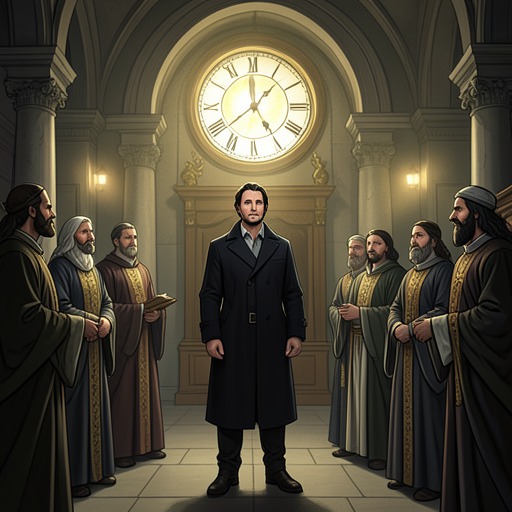
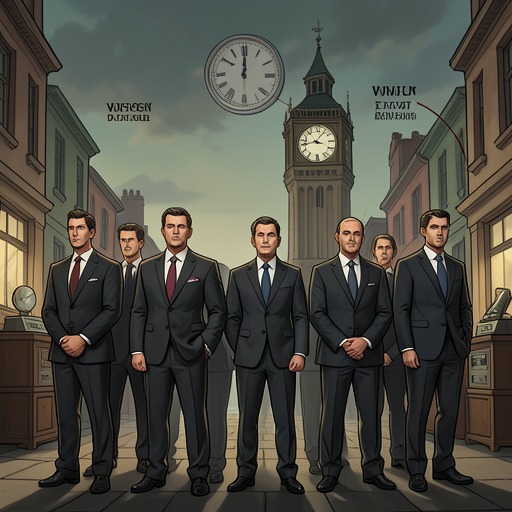
The name Egon enters the story as a practical answer to a problem created by the Gleisters’ multiplication. At their gathering, the counterparts recognize that continuing to call themselves Charlie Gleister would make communication impossibly confusing. The tallest among them is elected chairman and suggests that each adopt an unusual first name; he chooses Egon and calls a recess so the others can rename themselves. The naming is not merely ceremonial: it lets the assembled Gleisters distinguish their separate identities without erasing their shared family name.
The chairman’s election begins just as pragmatically. Charlie Gleister recalls that, among certain Native American groups, the tallest man might be chosen to lead a war or hunting party, though he is uncertain which group he has read about. The other Gleisters readily agree, and the tallest is quickly selected and sent to the stage. Egon’s authority thus rests on an improvised precedent and collective assent, rather than on a claim of inherited rank. The choice gives him a role from which to organize the assembly—and, soon, to name its political purpose.
Chairman of the Resistance
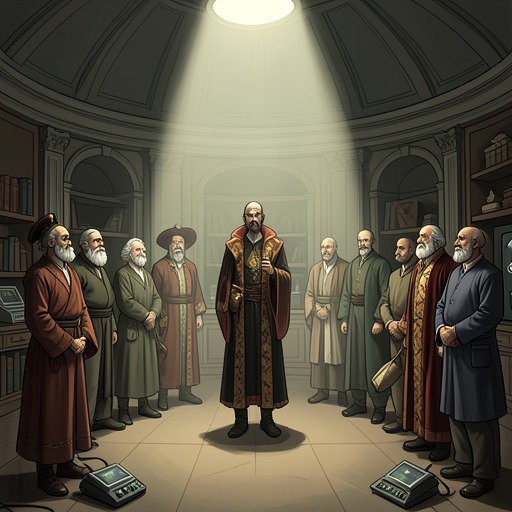
Addressing the gathering as the Gleister Coequality Line of Potentialities, Egon welcomes counterparts who reached the location by deliberate search, by accident, or while traveling elsewhere. He identifies it as a Gleister collection point, although its reason for attracting so many versions of the same family remains unclear to him. He then names it the Time-Space Center for Resistance to the Rule of the Emperor Mingus. The title makes the assembly’s purpose explicit: the Gleisters understand themselves as the only serious threat to Mingus’s reign.
Egon also connects that political danger to personal vulnerability. He tells the assembly that many Gleisters experienced inexplicable near-fatal accidents before inventing the time machine, and that some of those incidents were surely caused by Mingus. He warns that further attempts on their lives are to be expected. His leadership therefore combines a declaration of resistance with a warning about its cost. Yet his speech ends with an invitation for others to speak, and the question of Mingus’s identity remains open when Chalmers Gleister asks whether anyone has discovered who the emperor is.
From Survivor to Emperor
The assembly’s conflict becomes immediate when Mordecai-Mingus turns a gun on Egon. Hieronymous Gleister urges Mordecai to give him the weapon, arguing that time travel requires events to be overdetermined and that there must be a second emperor. Mordecai aims at Egon and pulls the trigger, but the attempt does not kill its intended target: Mordecai stiffens and falls, and the gun lands at Hieronymous’s feet. Hieronymous picks it up, checks Mordecai, and confirms that he is dead. Egon concludes that they appear to have a new emperor.
In the exchange that follows, Egon hefts the weapon and asks whether his cousin has imperial ambitions. Hieronymous says that he has ambitions, but not imperial ones, and mentions a premonition. Egon then declares that he is no longer Egon and renames himself Mingus, invoking symmetry as he does so. Hieronymous’s premonition is that the emperor is the slave of time. The scene binds Egon’s change of name to the political role he had just opposed: the resistance’s chairman becomes the figure whose rule the resistance was formed to challenge. The stated symmetry and the premonition make this reversal part of the story’s time-travel logic, not simply an ordinary transfer of office.
The Recurring Imperial Role
A later scene shows Charlie Gleister in an imperial audience room, with statistics on a table recording more than twelve million Gleisters settled to date and more arriving every minute. Charlie gives a young Egon Gleister a laser gun; Egon thanks him, presses the button on his time machine, and disappears. Charlie remains alone and recognizes that he, too, must take his turn as emperor. As the Gleisters’ termination proceeds, he and the others will have to take all the family’s roles until Charlie is the only one left, as at the beginning.
This departure places Egon inside a cycle that exceeds any single version of the character. The later Egon is handed the weapon and sent into time, while Charlie anticipates his own turn in the imperial role; the scene does not establish that this traveler is the same individual as the chairman who renamed himself Mingus. Instead, the repeated name and repeated assignment of roles make Egon one participant in a larger succession. The first chairman’s rise from elected organizer to emperor and the later traveler’s departure with the laser gun together show how the resistance and the imperial order are entangled in the Gleisters’ recurring history.
Narrative Role
Egon’s most consequential change is not a physical transformation but a political and nominal one. He begins as a provisional chairman chosen by his peers, speaks for a collective threatened by Mingus, survives a lethal confrontation, and takes the emperor’s name. That sequence turns the effort to oppose power into part of the mechanism by which power continues. The later image of another Egon disappearing into time sharpens the irony: the cycle is maintained through people who inherit roles, weapons, and names even as the story’s characters recognize its repetitions. Egon therefore matters less as a solitary, fully individuated biography than as a recurring hinge between resistance and rule.